
How electrification is shaping construction equipment trends in Europe

How electrification is shaping construction equipment trends in Europe
Electrification is moving beyond compact machines to reshape Europe’s concrete and deep foundation equipment markets. For businesses tracking construction equipment trends in Europe, the strategic question is no longer simply which machines can go electric, but where charging capacity, duty cycles, and lifecycle economics support investment. Battery-electric mixer trucks, electrically driven concrete pumps, and electric piling rigs are changing procurement discussions. Yet adoption remains uneven: a machine that works well on a grid-connected urban project may be a poor fit for a remote site with uncertain power access.
The market is therefore moving toward several electrification models rather than one universal replacement for diesel. Understanding those differences matters more than counting electric models in a manufacturer’s catalogue.
Europe’s transition is being shaped project by project
Urban construction provides a strong operational reason to electrify. Removing engine exhaust at the point of use can improve local working conditions, particularly around enclosed work areas and densely occupied sites. Lower engine noise can also help, although it does not make drilling, vibrating, or concrete placement silent. Tool-ground interaction, hydraulic systems, cooling fans, and material handling remain significant noise sources.
Policy signals need careful interpretation. EU Stage V rules address pollutant emissions from engines in non-road mobile machinery; they are not a blanket requirement to replace construction equipment with battery-electric alternatives. Road-going truck chassis operate under a different regulatory framework. Municipal access rules, construction permits, and client tender requirements may create additional constraints, but their scope varies by location and contract.
For fleet owners, that distinction has commercial consequences. A tender may require zero exhaust emissions during site operation without requiring electric propulsion on the journey there. Elsewhere, a road-access restriction may make the chassis just as important as the working equipment. Procurement teams should translate each requirement into an operating condition before specifying the machine.
Concrete equipment is splitting into different electrification pathways
Mixer trucks: the route and the drum must be assessed together
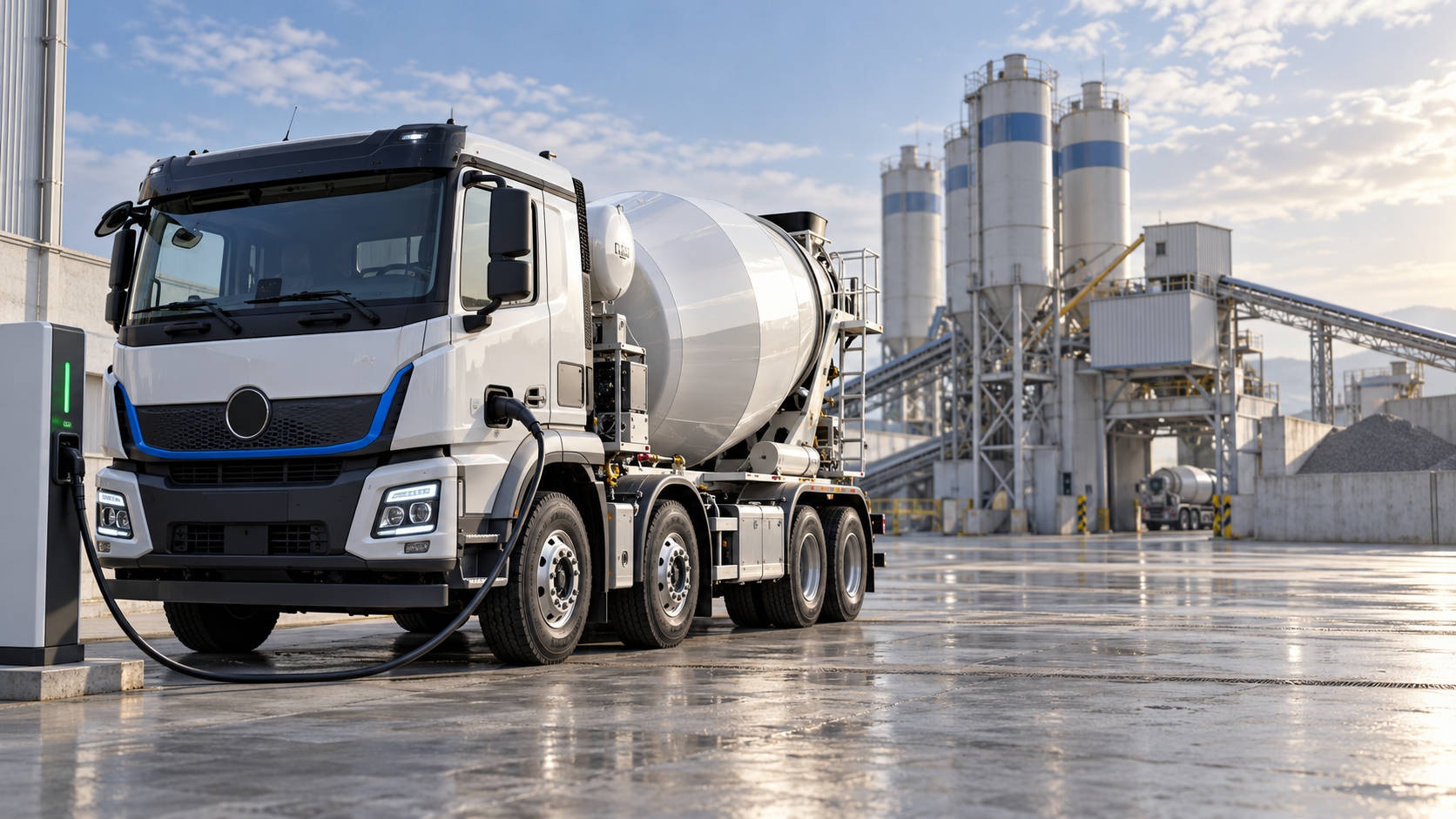
Concrete mixer trucks have an attractive starting point: they repeatedly return to batching plants, creating opportunities for depot charging. But their energy demand extends beyond driving. Drum rotation, loaded travel, gradients, congestion, waiting at the site, and seasonal conditions all affect the working day. A quoted driving range alone cannot establish whether a truck will complete its delivery schedule.
Battery weight also needs to be evaluated against the actual chassis configuration and applicable vehicle-weight rules. If usable concrete payload falls, additional trips can erode the expected operating benefit. Conversely, a predictable delivery radius and sufficient charging time may support electrification without major scheduling changes. The useful comparison is cost per delivered cubic metre, not electricity cost per kilometre.
An electric drum drive should not be confused with an entirely battery-electric truck. Electrifying the mixing system can reduce engine dependence during parts of the cycle while leaving road transport diesel-powered. Both approaches have a place, but they solve different emissions and operating problems.
Concrete pumps: stationary operation changes the calculation
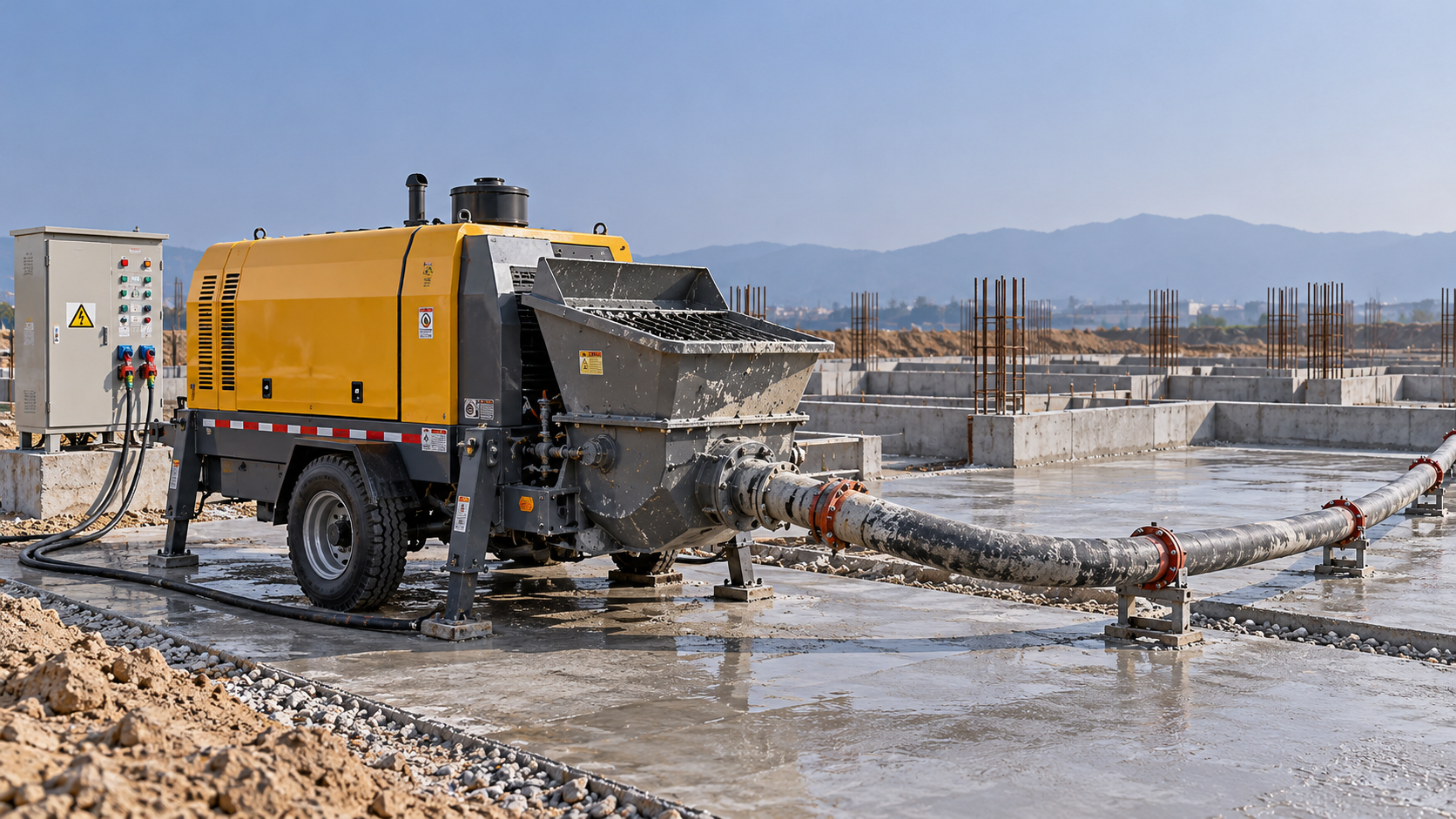
A truck-mounted concrete pump travels between jobs but spends much of its productive time stationary. That makes electrically powered pumping worth assessing separately from electric road propulsion. Where a suitable supply exists, external electrical power can support pumping without carrying enough battery capacity for the entire placement operation.
The challenge is matching power availability to the pour. Delivery height, pipeline length, concrete rheology, required output, and pumping pressure influence demand. Maximum flow and maximum pressure figures should not be assumed to occur simultaneously; the manufacturer’s operating envelope matters. A supply adequate for a routine slab pour may not support a more demanding pumping configuration.
Continuity deserves particular attention. Once trucks are dispatched and a continuous pour begins, an electrical interruption becomes a concrete logistics problem, not merely a machine fault. Backup arrangements must address safe changeover, pumping availability, and cleanout requirements. Backup diesel operation may also conflict with the project’s emissions conditions, so it cannot simply be assumed acceptable.
Deep foundation machinery exposes the limits of simple battery comparisons
Rotary drilling and piling equipment face highly variable loads. Drilling through soft material is not equivalent to cutting competent rock, even when the planned pile diameter and depth are unchanged. Casing installation, extraction, crowd force, rotary torque, and auxiliary systems can substantially change the energy profile. Average consumption from an unrelated project is a weak basis for specifying battery capacity.
Electric motors can deliver controllable torque, but many machines retain hydraulic transmission and working functions. Electrification does not eliminate hydraulic losses, cooling requirements, seal wear, or tooling consumption. A rig still needs to deliver the required mechanical performance at the tool throughout the intended shift.
Cable-powered operation can be practical where the rig works within a manageable area and a suitable supply is available. Its constraint is site organisation: cable routing must coexist with cranes, reinforcement cages, spoil removal, tracked movements, and changing working platforms. Battery systems avoid a continuous tether but introduce charging and energy-storage considerations. Neither arrangement is automatically superior.
Noise-sensitive piling adds another distinction. Replacing the diesel engine does not remove the impact noise of a hammer or the ground-borne effects of vibratory installation. Static pressing may suit some projects, but feasibility depends on ground conditions, pile design, reaction arrangements, and access. The installation method and the power source need separate engineering decisions.
The batching plant is becoming an energy-management hub
Many batching-plant functions already use electric motors. The emerging change is the addition of vehicle charging and potentially other fleet-energy demands to a facility designed around concrete production. Mixers, conveyors, compressors, dust extraction, and truck chargers may compete for the same connection capacity.
This is where charging strategy becomes a production decision. Returning trucks may need energy at the same time that the plant is handling a morning dispatch peak. Smart charging can stagger loads, but only within the delivery schedule’s available flexibility. Stationary storage may help manage short peaks; it cannot compensate indefinitely for an undersized incoming supply.
For DFCS, examining batching, transport, pumping, and foundation equipment together provides a useful market perspective: electrification changes the connections between assets, not just individual machines. A vehicle purchase can trigger switchgear upgrades, revised yard layouts, and new dispatch rules. Those dependencies belong in the investment case from the outset.
Lifecycle economics depend on productive work, not purchase price alone
Electric equipment may offer lower energy costs and reduced engine-related maintenance, but neither guarantees a lower total cost of ownership. Finance costs, utilisation, electricity tariffs, connection works, charging losses, insurance, and residual value can change the result. For concrete and foundation contractors, lost production can outweigh modest savings in energy expenditure.
A useful financial model should test a normal working day and a difficult one. The difficult day might include cold weather, a longer delivery route, harder ground, or a delayed pour that removes the planned charging window. If the machine only meets its economic target under ideal conditions, the investment is exposed.
- Measure the production unit: use delivered concrete volume, completed pile metres under defined conditions, or another relevant output measure—not operating hours alone.
- Separate shared infrastructure costs: distinguish investment supporting several machines from equipment needed for one asset.
- Read battery warranty conditions: check throughput limits, operating-temperature requirements, capacity-retention provisions, and exclusions.
- Price service interruptions: establish who can diagnose high-voltage faults, where replacement components are held, and what recovery arrangements exist.
Carbon claims require similar discipline. Zero tailpipe emissions describe operation at the machine, not the complete lifecycle. Electricity supply, battery manufacture, utilisation, and equipment life influence the broader result. Electrifying concrete handling also does not remove emissions associated with cement production; equipment and material strategies address different parts of the project footprint.
What this means for manufacturers and fleet investment
The direction of travel is clearer than the pace. European equipment portfolios are likely to remain mixed because applications differ too much for a single power architecture. Battery-electric machines, externally powered systems, and transitional configurations will compete on operating fit. A long-duration, grid-connected project presents a different opportunity from short assignments across dispersed sites.
For manufacturers, credible application support will matter alongside hardware. Buyers need duty-cycle modelling, realistic power requirements, charging compatibility information, and service coverage. For rental businesses, utilisation must be considered alongside the ability to deploy equipment to sites that can actually power it. An electric machine awaiting a suitable project is still an idle asset.
A sensible first investment is often a repeatable application where energy use and production can be measured clearly. Establish the baseline, confirm the electrical supply, and test representative working conditions before expanding the fleet. The strongest electrification decision is not the one with the largest battery or the earliest delivery date. It is the one that can complete the contracted work reliably, with its infrastructure and operating costs understood.
 How electrification is shaping construction equipment trends in EuropeTime : Oct 29, 2026
- When do zero-emission regulations apply to construction equipment?Time : Oct 26, 2026
- Which modern construction techniques suit Middle East heat and water limits?Time : Sep 29, 2026

Industry Briefing
Get the top 5 industry headlines delivered to your inbox every morning.