
How concrete pump placement affects high-rise commercial pours

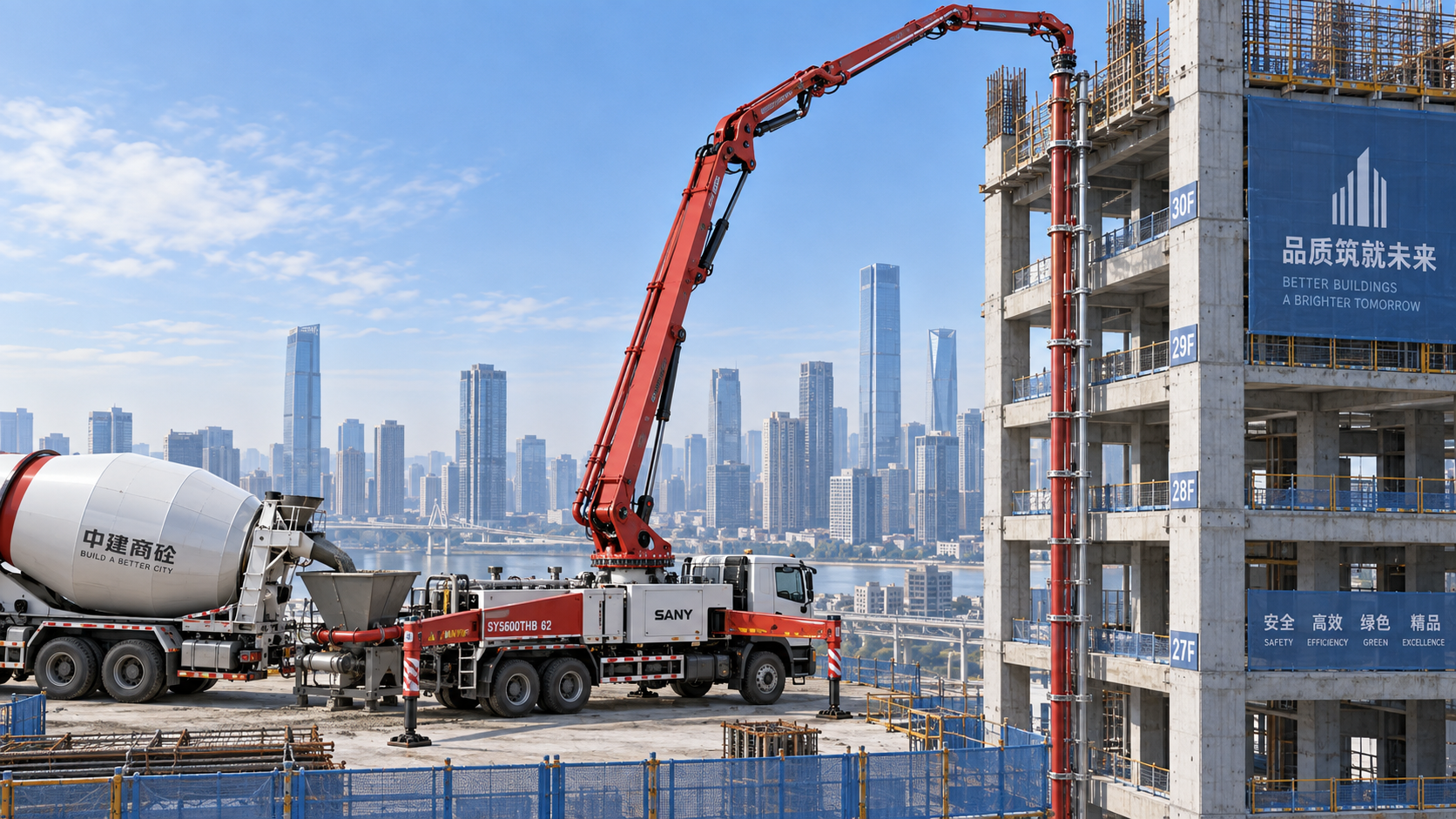
Concrete pump placement is not a logistics detail at a high-rise commercial pour; it is part of the placement design. The position of the pump, the first sections of pipeline, the route through the structure, and the location of truck discharge all determine whether concrete arrives at the deck at a stable rate and within the workable window assumed by the mix design.
A pump location that appears convenient on a site access drawing can create excessive line pressure, slow truck turnaround, difficult hose handling, or a blockage point that stops a critical slab pour. Conversely, a well-positioned pump may reduce rehandling, shorten the effective pumping path, preserve a more consistent placing rhythm, and make it easier to recover from a delayed truck or temporary equipment interruption. For commercial concrete for high rise construction, placement planning must therefore be coordinated with structural sequencing, mix design, traffic control, temporary works, and the available pumping fleet.
The pump’s location changes the real pumping duty
Vertical height is only one component of pumping demand. Concrete must overcome static head, friction along the pipeline, resistance at bends and reducers, and the additional pressure caused by the rheology of the mix. A pump serving a level 25 deck through a direct, well-supported vertical line may operate more predictably than one serving a lower level through a long horizontal route containing multiple bends, elevation changes, and temporary diversions.
This is why “nearest to the building” is not always the best placement criterion. The useful question is: What is the lowest-risk route from the truck hopper to the placing point for the full duration of the pour?
For a boom pump, the ground setup position affects both boom reach and boom geometry. Extending a boom near the edge of its working envelope can reduce flexibility for moving across a wide floor plate. It may also require more frequent repositioning, interrupting the concrete flow and increasing the chance of cold joints at boundaries between placement zones. A more central setup position, if site conditions permit, can offer a better working arc even when it requires more careful traffic management.
For a stationary pump and pipeline system, the pump may sit some distance from the building, but every added metre of pipe is not equivalent. Straight horizontal pipe usually creates less operational difficulty than repeated elbows, sharp route changes, poorly aligned couplings, or sections exposed to movement. The route should be evaluated as a pressure system rather than simply measured as a distance.
Ground conditions and outrigger space are part of placement capacity
A boom pump can only deliver safely if its setup area supports the imposed loads and allows outriggers to be deployed correctly. A nominally open location may still be unsuitable because of basement slabs, utility corridors, recently backfilled ground, excavation edges, voids, drainage structures, or loading restrictions above underground works. A compact high-rise site often has limited room for repositioning once formwork, reinforcement deliveries, and ready-mix trucks begin to occupy the perimeter.
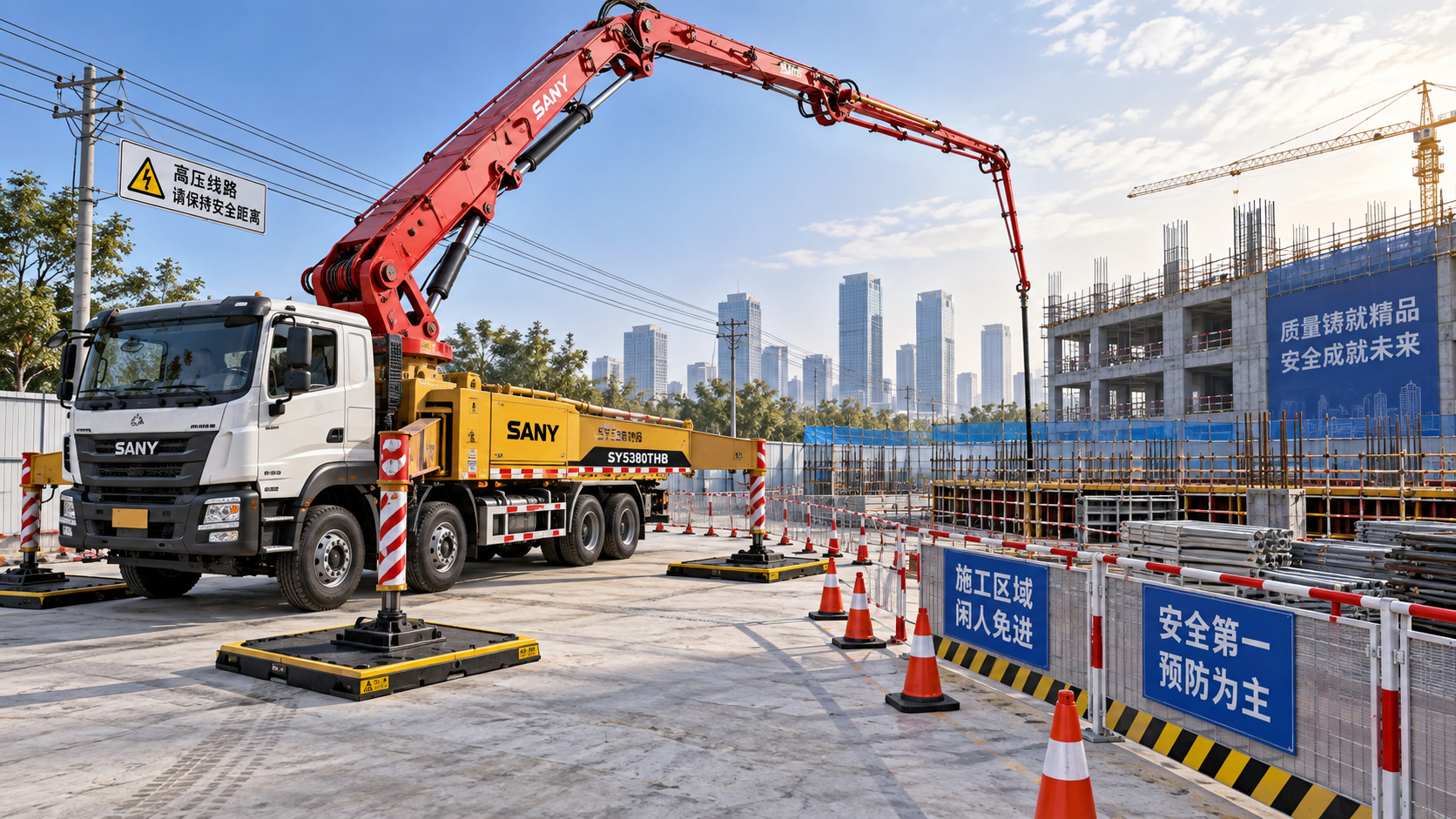
The pump setup plan needs a verified bearing arrangement, including any required outrigger pads or engineered load-spreading measures. This should not be treated as an equipment supplier issue alone. The condition of the supporting surface can change as excavation progresses, crane operations shift, temporary roads are altered, or basement works are completed.
Placement also depends on clearance. Boom movement must remain clear of tower cranes, climbing protection systems, façade screens, power lines, adjacent properties, and temporary structures. The important constraint is not only the boom’s maximum reach on paper, but its usable sweep after exclusion zones and obstructions are considered. A pump position that forces the operator to work repeatedly around a crane mast or building corner can turn a theoretically adequate setup into a slow and exposed operation.
Truck access can become the limiting factor before pump output does
High-rise pours often fail to achieve the planned placing rate not because the pump lacks capacity, but because trucks cannot feed it consistently. The pump hopper is a buffer, not a storage system. If trucks queue away from the discharge point, wait for reversing access, or become trapped behind other site traffic, the hopper level drops and the placing crew loses continuity.
The selected pump position should allow a truck to approach, discharge, and leave without crossing the boom’s outrigger zone or conflicting with other heavy movements. One-way circulation is generally easier to control than manoeuvres that require repeated reversing in constrained space. Where a one-way route is impossible, the turning area, banksman arrangements, pedestrian separation, and recovery route for an immobilised vehicle should be defined before the pour begins.
Truck-to-pump alignment matters as well. Awkward discharge angles, insufficient clearance for chute adjustment, or a hopper position that forces prolonged reversing can add small delays to every load. Across a large commercial slab, these delays accumulate into lower effective output. They also make delivery timing less predictable, which is particularly problematic when the slab sequence depends on maintaining a continuous wet edge.
Batch plant dispatch should be planned against the actual site cycle time, not the theoretical pump output quoted under favourable conditions. The relevant cycle includes loading, travel, gate entry, queueing, discharge, washout or cleaning provisions, exit, and return. If access routes are shared with public traffic or deliveries for other trades, the dispatch plan needs enough flexibility to avoid creating a false impression that more trucks alone will solve the issue.
Pipe routing affects concrete quality as well as productivity
A pipeline should protect the concrete from unnecessary stress and segregation risk while delivering it at a controllable rate. Poor routing can cause pressure spikes, excessive wear, and unstable flow. Long runs with multiple changes in direction are more sensitive to variations in aggregate grading, sand content, cementitious material, admixture dosage, temperature, and moisture condition.
The practical implications are especially important for mixes used in commercial high-rise work. Higher-strength concretes, pumpable mixes with supplementary cementitious materials, self-consolidating concrete, and mixes designed for extended workability can each behave differently under pressure. A mix that performs well in a short ground-level pump line should not automatically be assumed suitable for a tall vertical rise and a lengthy distribution system.
Pipeline layout should avoid unnecessary reductions in diameter, abrupt bends, unsupported sections, and locations where pipe movement can damage formwork, reinforcement, edge protection, or finished work. Bends deserve particular attention because they experience higher wear and can become blockage points when the mix consistency changes. Routes passing through floor openings or around transfer structures require adequate restraint and protection so that line movement does not transfer unintended loads into temporary works.
The end hose is also part of the route. If the final hose length is too short, the boom or pipeline must be moved more often. If it is too long, it becomes harder to control, adds handling strain, and can encourage crews to drag the hose across reinforcement or formwork rather than reposition it safely. The right arrangement enables deliberate placement into the intended zone without using the hose as an improvised tool for spreading large volumes of concrete.
Placement zones should be designed around realistic reach, not nominal reach
For a broad floor plate, a pour sequence must account for how far the hose can reach while remaining manageable and how the crew will move from one bay to another. A single pump position may cover the full slab geometrically but still produce inefficient movement at perimeter zones, around cores, or beneath overhead constraints.
Breaking the pour into zones can reduce this problem, but zoning only works when the sequence matches the concrete’s setting behaviour and the structural placement requirements. The boundary between zones should not become an unplanned interruption point. If the next truck, pump repositioning, or line extension is delayed, the crew may face an undesirable delay between adjacent placements.
The same issue appears in vertical elements. Columns, walls, core sections, transfer beams, and heavily reinforced zones do not all accept concrete at the same rate. A pump route that serves an open slab efficiently may be poorly suited to a congested core wall requiring slower, controlled lifts. When one pump is expected to serve both types of work, the programme should acknowledge the change in placing rate rather than assume a uniform output throughout the shift.
Pressure planning must be tied to the actual concrete specification
Pump placement cannot be finalised independently of the concrete supplier and mix approval process. Pumpability is influenced by more than slump at the point of discharge. Aggregate shape and maximum size, fines content, binder composition, admixture system, air content, temperature, and time since batching all affect how concrete moves through a line.
A high-rise placement plan should identify the proposed pump type, line diameter, vertical rise, horizontal length, number and type of bends, anticipated discharge rate, and any changes in line configuration during the pour. This information gives the concrete producer a meaningful basis for confirming that the approved mix is appropriate for the route. It also helps distinguish a mix-related problem from a system-related problem if pressure rises unexpectedly during operations.
One recurring error is treating additional water as a field remedy for difficult pumping. Water addition can change strength development, durability-related properties, finishability, and segregation resistance. Any adjustment must remain within the approved concrete control process. If workability retention is a concern, the response should be coordinated with the mix design and delivery timing rather than improvised at the hopper.
Priming is equally important. The initial lubricating material must be managed so that it does not enter structural work in a way that compromises the specified concrete. The procedure for receiving, diverting, or disposing of primer should be established before pumping starts, particularly where the first placement area is a critical structural element.
Repositioning a pump is a schedule event, not a minor interruption
On dense urban sites, it may be necessary to move a boom pump during a large pour because of reach limits, access conflicts, or changing work fronts. That move should be planned as a controlled transition with a defined point in the placement sequence. It requires more than selecting a second parking location.
The team must consider whether concrete can continue to be placed while the equipment is moved, whether a standby pump is needed, how the active line will be cleaned or secured, and whether the pour joint location is acceptable if continuity is lost. Access routes must remain clear at the time of relocation, not merely on the pre-pour drawing. A route that is open in the morning can be blocked later by reinforcement deliveries, crane operations, or accumulated materials.
For stationary systems, changing the line route at higher floors should receive similar attention. A line extension can affect pressure, anchorage requirements, access around the riser, and the time required to prime and restart. The decision to extend a vertical line should be based on the building sequence and expected duration of use, not delayed until the current route becomes operationally marginal.
Blockage response should be designed before the first truck arrives
A blockage is not simply a maintenance inconvenience. During a high-rise pour, it can disrupt delivery sequencing, create concrete waste, expose crews to pressure-release hazards, and compromise the continuity of structural placement. The most effective response begins with prevention: suitable mix control, clean and correctly assembled lines, restrained pipework, a sensible route, and active monitoring of pump pressure and hopper behaviour.
When pressure rises or flow becomes erratic, continuing to force the system can worsen the obstruction. The response procedure should identify who can stop the pour, who assesses the line, how truck deliveries are held or redirected, and how the affected placement area is protected. No one should attempt to open a pressurised coupling or stand in the likely path of a released line. The stored energy in a concrete delivery system is a serious hazard, particularly where lines are elevated or pass through confined work areas.
A backup plan does not always require a fully redundant pump on site. It may involve a verified call-off arrangement, an alternative line connection, reserved access for replacement equipment, or a defined point at which the pour can be safely terminated. The appropriate level of contingency depends on pour size, structural sensitivity, site access, and the consequence of losing continuity.
Placement planning works best when it is treated as a coordinated site system
The pump is only one component of the system. The batch plant must understand the pumping route and required consistency. The delivery plan must reflect real access constraints. Formwork and reinforcement teams must protect the pump route and maintain hose access. Crane and logistics plans must avoid conflicts with boom movement and truck circulation. Safety controls must cover outrigger stability, exclusion zones, pipe restraint, communication, and emergency response.
A useful pre-pour review tests the planned arrangement against the actual day of work: the current slab level, available hardstanding, crane position, traffic route, weather exposure, line condition, pump capacity, concrete mix, placement sequence, and fallback arrangement. Drawings are necessary, but they cannot replace checking whether the site still matches the assumptions made when the plan was prepared.
The central decision is not whether the pump can physically reach the pour. It is whether the selected position can sustain controlled delivery without creating avoidable pressure, traffic, quality, or safety risks. When pump placement is resolved early and reviewed as the building rises, high-rise commercial pours become more predictable: concrete reaches the intended location at the required rate, the placing crew works within a stable sequence, and interruptions are less likely to dictate the structural programme.
Industry Briefing
Get the top 5 industry headlines delivered to your inbox every morning.