
Construction safety solutions that reduce pump truck setup risks

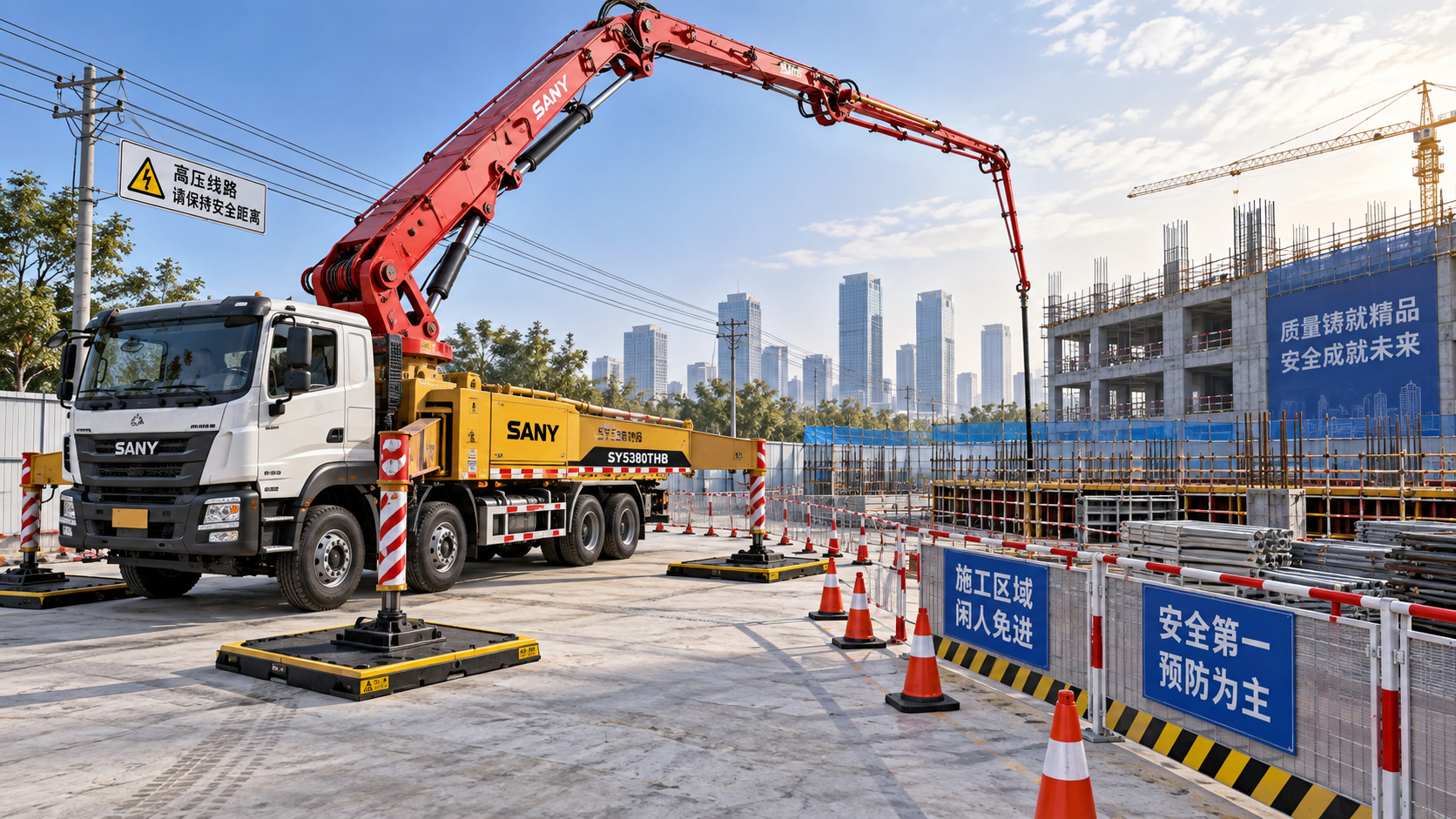
Before a concrete pump truck places a single cubic meter of concrete, the setup area may already contain the conditions for a serious incident: soft fill near an excavation, a sloping access road, buried services, overhead power lines, incomplete traffic control, or an outrigger pad placed on ground that has not been properly assessed. Setup errors are often made under schedule pressure, when the pump arrives before the placing crew, the pour sequence changes, or space is tighter than expected.
The most effective construction safety solutions do not rely on one inspection or one operator decision. They combine a site-specific setup plan, verified ground support, exclusion controls, clear communication, and equipment checks that continue throughout the pour. For project leaders, the central question is not simply whether the pump truck can fit on site. It is whether the truck can remain stable, accessible, and controllable through its full boom range, changing concrete loads, and the movement of nearby people and vehicles.
Start with the setup zone, not the pump truck
A pump truck may appear stable while parked, yet its outriggers can impose concentrated loads that the underlying surface cannot support. Freshly backfilled trenches, utility corridors, manhole covers, recently disturbed ground, unsupported slab edges, and voids beneath paving are especially problematic because their condition is not always visible from the surface. A firm-looking area can still settle once outrigger load is applied.
The setup zone should be reviewed before the equipment reaches the gate whenever possible. The review needs to consider the pump truck’s dimensions, outrigger footprint, boom reach, delivery route, truck mixer approach, and emergency access at the same time. Treating these as separate decisions frequently creates conflicts later: a pump may be positioned for reach but block mixer circulation, or a safe outrigger location may leave the boom too close to a power line.
Information to confirm before positioning
- Exact location of excavations, basements, retaining structures, trenches, culverts, pits, and recently backfilled areas.
- Known underground utilities, chambers, drainage structures, temporary services, and any area where the ground bearing condition is uncertain.
- Surface type and condition, including slope, standing water, soft shoulders, loose aggregate, cracked pavement, frozen ground, and recently placed concrete.
- Overhead restrictions such as power lines, building projections, tower crane paths, scaffolding, temporary lighting, and tree limbs.
- Access and turning paths for the pump truck and mixer trucks, including whether reversing will be necessary.
- Where hose handlers, spotters, finishing crews, delivery drivers, and other trades will stand while concrete is being placed.
Where drawings, utility information, or ground records do not provide enough confidence, the area should not be treated as automatically suitable. The responsible site team needs a defined method for deciding whether to relocate the pump, improve the support surface, use larger engineered bearing pads, alter the pour sequence, or select a different delivery arrangement. Outrigger pads distribute load; they do not make weak or unknown ground safe by themselves.
Ground support is a load-control issue
One of the most persistent setup mistakes is choosing pads by appearance rather than by the load path. Small timber pieces, damaged mats, stacked materials, or improvised supports can crack, tilt, slip, or sink. They may also create a false sense of security because the outrigger initially looks level. As the boom is extended or the hopper is charged, settlement can become visible too late.
Support materials need to be sound, appropriately sized, placed flat, and centered beneath the outrigger floats. They should sit on a surface capable of carrying the load without local crushing or rotation. Avoid bridging gaps, placing pads partly over edges, or using multiple loose layers that can shift. Where a slope must be accommodated, the solution must be designed and approved for the condition; using loose blocks or wedges beneath pads is not a substitute for proper leveling.
Monitoring must continue after setup. An outrigger that begins to sink, a pad that rotates, fresh cracking in pavement, a change in truck level, or repeated stabilizer alarms should be treated as a stop-work signal. Trying to compensate by changing boom position while the support system is moving can worsen the instability. The boom should be brought to a safe position in accordance with the equipment procedure, pumping stopped, and the support condition corrected before restarting.
Control the space around outriggers and the boom
Pump truck setup creates two separate but connected exposure zones: the stabilizer zone at ground level and the boom operating envelope above and around the placement area. Both need deliberate control. Workers may focus on the end hose and overlook the fact that an extended outrigger can obstruct a walkway, vehicle route, or escape path. Delivery drivers may arrive while stabilizers are being deployed and attempt to pass through a space that has become unsafe.
A clear physical boundary is better than a verbal warning alone. Barricades, cones, temporary fencing, signs, and controlled access points should reflect the actual movement area of the truck, mixers, and personnel. The boundary must allow for the full outrigger span, not merely the truck body. It also needs to be adjusted when the placement location changes.
Overhead hazards require the same discipline. The boom operator and the site team must identify electrical lines before deployment, including lines that may be obscured by buildings, poor lighting, or other temporary works. The required clearance and control method depend on the applicable rules, line condition, voltage, and site arrangements. When safe clearance cannot be assured, the pump position or work method must change. A spotter cannot make an unsafe boom path acceptable; the spotter supports an already planned and controlled operation.
Traffic management during concrete delivery
Congestion is a common setup multiplier. A pump truck may be correctly stabilized, but the operation remains exposed when mixers reverse near hose handlers, forklift routes cross the discharge area, or workers cut through the truck’s blind spots. Establish a delivery sequence and one-direction movement where space permits. Identify holding areas for arriving mixers so they do not queue beside deployed outriggers or beneath the boom.
Use a designated person to coordinate vehicle movements when drivers cannot see the intended route clearly. That person should not simultaneously manage hose placement, inspect ground settlement, and direct several vehicles. The role needs enough attention to stop a movement before it conflicts with people, equipment, or access routes.
Make setup a verified sequence rather than a rushed routine
Routine can be useful, but it becomes dangerous when the crew assumes every site is equivalent. A repeatable sequence helps prevent skipped steps while still requiring the operator and site supervisor to respond to local conditions. The sequence should begin before outriggers are extended and end only after the pump is safely secured for work.
- Confirm the designated position. Compare the planned location with actual access, surface condition, overhead hazards, placement reach, and traffic routes. Do not force the truck into a preselected position that no longer matches the site.
- Establish the exclusion area. Keep pedestrians, nonessential trades, and vehicles clear while the truck is maneuvered and stabilizers are deployed.
- Inspect the support points. Check each outrigger location for soft ground, edges, openings, service covers, debris, or water. Position suitable pads correctly before loading the stabilizers.
- Deploy and level according to the equipment procedure. Observe pad contact and truck attitude as loads transfer. Do not allow anyone to stand near moving stabilizers or between the truck and fixed objects.
- Verify boom path and hose route. Confirm clearances, safe operating space, and communication arrangements before unfolding the boom. The hose route should not create a trip hazard across active vehicle lanes or force handlers into pinch points.
- Conduct a short operational briefing. Cover stop signals, hose-handler positions, mixer approach, emergency communication, exclusion boundaries, and who has authority to stop pumping.
- Recheck after the first movements. Early boom movements and initial concrete loading can reveal settlement, clearance conflicts, or poor access arrangements that were not obvious at idle.
The briefing does not need to be lengthy, but it should address the actual pour. A vague reminder to “work safely” does not clarify where drivers stop, who signals them, how the end hose will be restrained, or what happens when a person sees an unstable pad.
Equipment condition matters before and during deployment
Construction safety solutions for pump truck setup also depend on the condition of the machine and accessories. Stabilizer controls, level indicators, interlocks, emergency stops, boom controls, delivery hoses, clamps, safety pins, and communication devices should be checked under the operator’s normal inspection process. A site plan cannot compensate for damaged equipment or a control fault that prevents the operator from accurately assessing setup status.
Particular attention is needed where equipment has been transported on rough access roads, worked repeatedly in abrasive concrete conditions, or stored outdoors. Hoses and couplings can be damaged by dragging, impact, excessive wear, or poor handling. A connection failure at the start of pumping can expose workers to sudden hose movement and concrete discharge. The delivery line should be supported and secured as required by the equipment and work method, with personnel kept clear during priming and pressure changes.
Digital indicators, remote controls, and stability-related systems can improve visibility, but they should be treated as aids to decision-making rather than replacements for ground assessment. A level display may show that the chassis is level while a pad is slowly pressing into weak soil. Operators still need visual confirmation of pad position, ground behavior, and the surrounding work area.
Set clear stop-work triggers before the pour begins
Teams often hesitate to stop because concrete is in transit and delay creates commercial pressure. That is exactly why stop-work triggers should be agreed before the first mixer discharges. When conditions are predefined, the decision is less likely to become an argument during a developing hazard.
- Any outrigger pad sinks, shifts, cracks, loses full contact, or approaches an edge.
- The truck’s level condition changes unexpectedly or stabilizer warnings occur.
- A vehicle, person, or new site activity enters the controlled setup area without effective separation.
- The planned boom path is compromised by overhead work, electrical hazards, wind conditions, or a changed placement location.
- Communication between the operator, hose handlers, and vehicle coordinator is lost or unclear.
- A hose, clamp, support, or delivery line shows damage, leakage, abnormal movement, or signs of blockage.
Stopping does not always mean abandoning the pour. It means restoring control: retracting or repositioning the boom as appropriate, securing the area, reassessing the condition, and restarting only when the support and work arrangement are confirmed. A brief controlled interruption is preferable to continuing until a manageable issue becomes a rollover, line failure, strike, or collision event.
Assign responsibilities without creating gaps
Safe setup is weakened when everyone assumes someone else checked the ground or controlled the delivery route. The pump operator has a critical role in equipment deployment and refusal of unsafe setup conditions. The site supervisor or responsible project representative must ensure the designated position, access arrangements, ground information, and trade coordination are adequate. Hose handlers need to understand their safe positions, signals, and authority to report unsafe conditions. Drivers need clear instructions on where to queue, reverse, discharge, and leave.
These responsibilities should overlap enough to catch errors but remain specific enough that checks are actually completed. For example, the site team may identify utility routes and exclusion boundaries, while the operator independently verifies each actual outrigger support point before transferring load. This avoids treating a general site approval as proof that each stabilizer location is safe.
Use the post-pour review to prevent the next setup problem
After the boom is folded and outriggers are retracted, the operation can reveal useful information for future pours. Record ground movement, access bottlenecks, mixer queuing problems, communication failures, hose-routing conflicts, or changes required during the job. The purpose is not to create paperwork for a routine pour; it is to prevent the same weak point from being accepted next time because the work happened to finish without an incident.
Where a location will be used repeatedly, the project team can improve it by defining approved pump positions, maintaining suitable access, marking no-outrigger areas, protecting known underground structures, and planning delivery circulation before the next concrete placement. That turns pump truck setup from a last-minute accommodation into a controlled part of the construction method.

Industry Briefing
Get the top 5 industry headlines delivered to your inbox every morning.