Before the first drill bit touches the ground, underground construction already carries risks that can shape budgets, schedules, equipment selection, and site safety.
For project managers and engineering leads, the challenge is turning subsurface uncertainty into drilling decisions that protect people, assets, and foundations.
Why Pre-Drilling Risk Decisions Matter More Than the Drilling Method
In underground construction, drilling performance is often judged by penetration rate, equipment power, and pile quality after work begins.
Yet many serious failures originate earlier, when incomplete ground intelligence is accepted as a manageable uncertainty rather than a project risk.
A drilling rig can be powerful, modern, and correctly operated, but it cannot compensate for unknown utilities, misread groundwater, or unstable strata.
For project managers, the key question is not simply whether drilling can start, but whether the site is ready to be drilled.
That readiness depends on geotechnical evidence, utility verification, access planning, environmental constraints, and an equipment strategy aligned with actual ground behavior.
The business impact is direct: fewer stoppages, fewer claims, safer crews, better productivity, and lower probability of redesign during construction.
Pre-drilling risk assessment also improves procurement decisions, because equipment selection becomes based on expected resistance, groundwater, depth, and spoil conditions.
This is especially important for deep foundations, rotary drilling rigs, piling machinery, basement construction, tunnels, and urban infrastructure upgrades.
Hidden Utilities: The Risk That Can Stop a Project Instantly
Utility strikes remain among the most disruptive risks in underground construction because they combine safety danger with immediate commercial consequences.
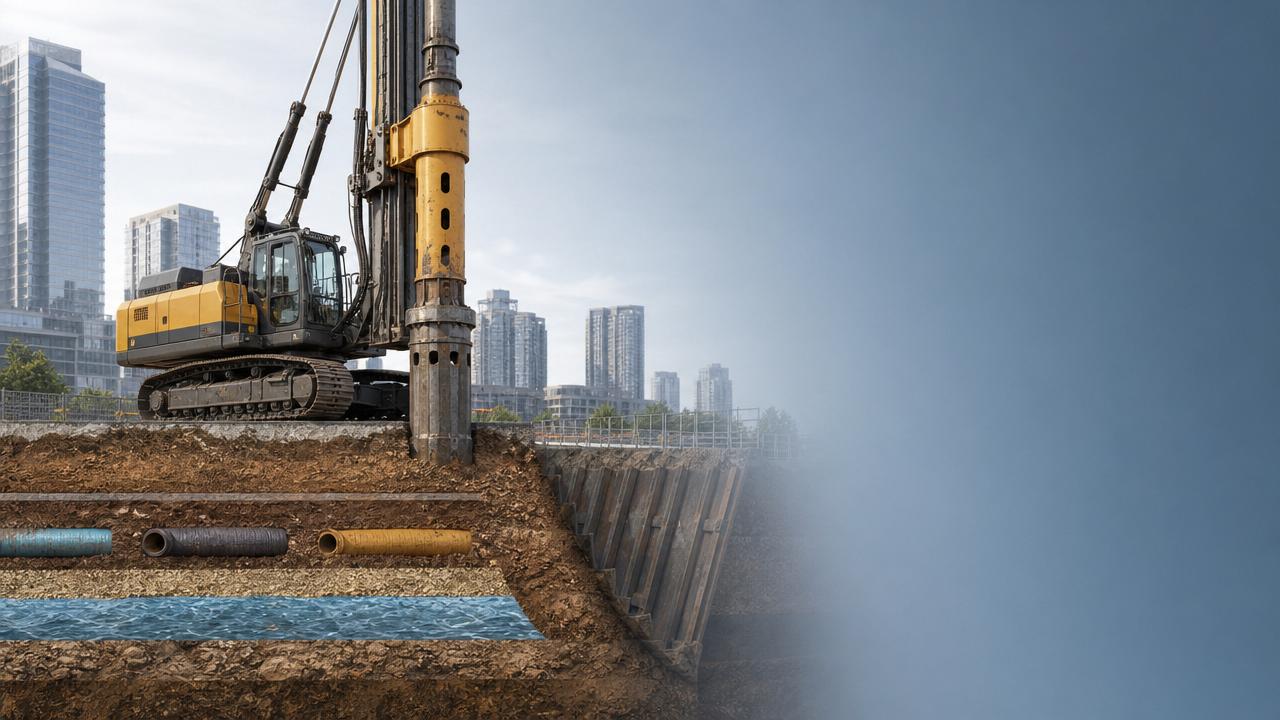
Gas lines, power cables, fiber networks, drainage pipes, and legacy services may not be accurately reflected in record drawings.
Older urban sites are especially problematic because infrastructure may have been rerouted, abandoned, repaired, or installed without complete documentation.
Project managers should treat utility drawings as clues, not proof, and require physical verification before drilling or piling begins.
Ground penetrating radar, electromagnetic locating, vacuum excavation, and targeted trial pits can reduce uncertainty when used together intelligently.
The aim is not only to locate utilities, but to understand clearance, depth tolerance, condition, and consequences of accidental impact.
A utility risk register should identify each asset owner, permit requirement, exclusion zone, protection method, and emergency contact pathway.
Where drilling must occur near live services, method statements should define reduced torque, restricted depth, spotter roles, and stop-work triggers.
This planning may look time-consuming, but it is far cheaper than evacuation, service interruption, regulatory investigation, or litigation.
Ground Conditions: What Boreholes Alone May Not Tell You
Geotechnical investigation is essential, but project leaders should understand its limits before relying on borehole logs alone.
Subsurface conditions can change dramatically between investigation points, especially in reclaimed land, river terraces, karst areas, and mixed urban fill.
A borehole may identify sand, clay, cobbles, rock, or obstructions, but drilling behavior depends on transitions and variability.
Rotary drilling rigs can face sudden torque spikes when soft layers give way to boulders, hard rock bands, or buried concrete.
Unanticipated cobbles may reduce productivity, damage tools, or require casing, core barrels, chisels, or alternative drilling sequences.
Loose sand and quicksand conditions can collapse boreholes, affecting pile integrity, concrete placement, and reinforcement cage installation.
For project managers, the practical question is whether the ground model supports the planned method with enough confidence.
That means comparing investigation data with nearby project history, geological maps, groundwater records, and contractor experience from similar formations.
Where uncertainty remains high, contingency planning should include alternative tooling, casing strategy, slurry support, spare parts, and productivity allowances.
A realistic ground risk allowance is not pessimism; it is a controlled investment in schedule credibility and safer execution.
Groundwater Pressure: The Risk Behind Instability, Delay, and Quality Defects
Groundwater is often underestimated because it is invisible until drilling exposes its pressure, flow path, or impact on stability.
High groundwater can destabilize excavations, wash fines into boreholes, reduce sidewall integrity, and complicate concrete placement during piling.
Perched water, artesian pressure, tidal influence, seasonal fluctuation, and adjacent dewatering can all change site behavior quickly.
Before drilling, project teams should confirm groundwater levels, expected variation, permeability, inflow rates, and discharge restrictions.
If groundwater control is needed, the design should consider wellpoints, deep wells, cut-off walls, casing, slurry, or staged drilling.
Each option has cost, permit, settlement, and environmental implications that must be visible before construction starts.
Dewatering may protect the excavation but cause settlement near roads, pipelines, historical buildings, or operating facilities.
In bored piling, uncontrolled groundwater can lead to necking, soil inclusions, weak concrete zones, or loss of pile capacity.
The correct response is not always aggressive pumping; sometimes temporary casing or slurry support gives better quality control.
Project managers should ensure groundwater assumptions are linked to the chosen drilling method, not treated as a separate engineering note.
Adjacent Structures and Vibration-Sensitive Surroundings
Urban underground construction rarely happens on an empty site, so surrounding assets must be treated as part of the risk environment.
Nearby buildings, retaining walls, buried tanks, railways, bridges, hospitals, laboratories, and heritage structures may impose strict movement limits.
Piling and drilling activities can generate vibration, noise, ground loss, settlement, and lateral movement depending on method and geology.
The risk is not only structural damage; it may involve business interruption, community complaints, monitoring disputes, and regulatory restrictions.
Before drilling, teams should complete condition surveys, movement predictions, baseline monitoring, and stakeholder communication for sensitive properties.
Vibration thresholds should be defined in measurable terms, with instruments installed before equipment mobilization rather than after complaints begin.
Where impact risk is high, method selection may favor rotary bored piles, static pressing, pre-drilling, or lower-vibration techniques.
In congested sites, logistics also influence risk because rig movement, crane access, concrete delivery, and spoil removal can affect neighbors.
For project leaders, early transparency with asset owners often prevents later escalation and supports faster approval of protective measures.
Equipment Selection: Matching Machinery to Risk, Not Just Diameter and Depth
Many project delays begin when equipment is selected mainly by pile diameter, drilling depth, or availability in the contractor’s fleet.
In complex underground construction, the better approach is to match equipment to ground resistance, access limits, environmental controls, and productivity risk.
A rotary drilling rig should be assessed for torque, crowd force, mast stability, tool compatibility, casing capability, and transport constraints.
Hard rock may require different buckets, core barrels, augers, teeth, wear protection, and maintenance intervals than mixed fill or sand.
Soft unstable layers may demand casing oscillators, polymer slurry, bentonite systems, or careful sequencing to prevent borehole collapse.
For piling machinery, vibration levels, pressing force, pile type, refusal criteria, and noise restrictions should guide method selection.
Concrete supply also matters because deep foundation quality depends on reliable batching, delivery timing, pumpability, and continuous placement.
If a concrete batching plant or mixer fleet cannot support the placement window, pile integrity may be compromised.
Project managers should request method-specific productivity assumptions, breakdown contingencies, spare tooling plans, and clear responsibilities for equipment changes.
The goal is not to over-specify machinery, but to avoid choosing equipment that has no margin for real site conditions.
Permits, Environmental Controls, and Compliance Risks
Regulatory risk can be as damaging as ground risk when permits, working hours, discharge limits, or noise controls are overlooked.
Underground construction often involves excavation spoil, drilling slurry, contaminated soil, groundwater discharge, concrete washout, and dust generation.
Each waste stream may require testing, segregation, licensed transport, disposal documentation, and environmental monitoring before removal from site.
Where contamination is possible, pre-drilling investigation should identify hydrocarbons, heavy metals, asbestos, industrial residues, or hazardous groundwater.
Failure to plan can stop drilling while samples are retested, waste classifications are revised, or disposal routes are renegotiated.
Noise and working-hour permits are equally important for urban piling and drilling near residential or commercial operations.
Low-carbon requirements are also increasing, influencing equipment choice, electric machinery options, concrete mix design, and logistics planning.
Project leaders should connect environmental controls with schedule planning, because compliant construction often requires slower movements and additional monitoring.
A strong compliance plan protects the project from fines, complaints, reputational damage, and forced changes after mobilization.
Access, Logistics, and Site Setup Risks Before Mobilization
A technically suitable drilling method can still fail if the site cannot safely receive, position, and support the equipment.
Large rotary drilling rigs and piling machines require verified access routes, bearing capacity, turning space, working platforms, and lifting zones.
Temporary platforms should be designed for actual equipment loads, including dynamic effects, crawler pressure, spoil stockpiles, and concrete trucks.
Soft ground, buried voids, weak slabs, and undocumented basements can create rollover, settlement, or platform failure risks.
Site teams should confirm delivery routes, overhead clearance, traffic management, crane interfaces, refueling areas, and emergency vehicle access.
Concrete logistics deserve special attention because bored pile quality depends on uninterrupted supply once placement begins.
If mixer trucks face congestion, batching delays, or long travel distances, cold joints and placement defects become realistic risks.
Spoil management must also be planned before drilling, including storage space, haulage timing, moisture control, and disposal documentation.
Good logistics planning converts drilling from a series of improvisations into a predictable production system.
Contractual and Commercial Risks Hidden in Technical Assumptions
Pre-drilling risk is not only an engineering issue; it directly affects contract price, claims exposure, and stakeholder confidence.
Ambiguous ground conditions clauses can create disputes when drilling productivity drops, obstructions appear, or groundwater control becomes more complex.
Project managers should review whether the contract clearly allocates responsibility for unforeseen conditions, utility damage, delays, and redesign.
Baseline reports should be referenced carefully, distinguishing information provided for guidance from conditions warranted by the employer.
Where risk is significant, tender documents should request method statements, risk allowances, alternate rates, and defined change mechanisms.
This helps avoid unrealistic low bids that later become delay claims, variation disputes, or quality compromises.
Commercial planning should include contingency budgets for additional investigation, changed tooling, extended casing, water control, and restricted working hours.
The best risk allocation is not the one that transfers every risk, but the one that places control with the capable party.
A transparent risk conversation before drilling usually costs less than an adversarial negotiation after production is disrupted.
A Practical Pre-Drilling Risk Checklist for Project Managers
Before authorizing drilling, project managers should require a clear readiness review that connects technical findings with field execution.
The first checkpoint is utility confidence: records reviewed, surveys completed, trial holes finished, exclusion zones marked, and emergency procedures agreed.
The second checkpoint is ground confidence: boreholes interpreted, variability assessed, obstructions considered, and contingency tools available.
The third checkpoint is groundwater control: levels measured, seasonal changes considered, discharge permissions obtained, and support methods confirmed.
The fourth checkpoint is surrounding asset protection: condition surveys completed, monitoring installed, thresholds agreed, and stakeholders informed.
The fifth checkpoint is equipment suitability: rig capacity, tooling, maintenance, access, platform design, and backup arrangements verified.
The sixth checkpoint is concrete and materials logistics: batching reliability, delivery sequence, pumpability, testing, and placement continuity confirmed.
The seventh checkpoint is compliance: permits, waste routes, contamination controls, noise restrictions, and environmental reporting responsibilities documented.
The final checkpoint is commercial alignment: risk ownership, reporting routes, change procedures, and stop-work authority clearly understood by all parties.
This checklist should not be treated as paperwork; it should become a decision gate before mobilization and drilling approval.
How to Turn Risk Intelligence Into Better Drilling Decisions
Risk assessment creates value only when it changes decisions, priorities, or controls before the drilling team reaches site.
If utilities are uncertain, the decision may be to perform additional trial holes or redesign pile positions.
If ground variability is high, the decision may be to mobilize stronger tooling, revise productivity targets, or phase the works.
If groundwater risk is severe, the decision may be to change bore support methods or secure discharge approvals earlier.
If nearby assets are sensitive, the decision may be to use lower-vibration machinery and expand instrumentation coverage.
If logistics are constrained, the decision may be to alter concrete supply routes, delivery windows, or equipment layout.
These decisions protect the project because they are made while options still exist and costs remain controllable.
For engineering leads, the most useful risk report is not the longest document, but the one that supports action.
It should rank risks by likelihood, consequence, detectability, owner, mitigation cost, and effect on drilling approval.
That structure helps leadership distinguish acceptable uncertainty from conditions that require investigation, redesign, or contractual clarification.
Conclusion: Drill Only When the Unknowns Are Managed
Underground construction will never be risk-free, because every project must work with hidden ground, buried assets, and changing site conditions.
However, the largest failures usually occur when uncertainty is ignored, simplified, or transferred without practical control measures.
Before drilling begins, project managers should focus on utilities, strata, groundwater, surrounding assets, equipment fit, logistics, compliance, and contracts.
When these areas are reviewed together, drilling becomes a managed engineering operation rather than an expensive experiment below ground.
The right preparation improves safety, protects budgets, supports schedule certainty, and strengthens the quality of deep foundation delivery.
For complex infrastructure and foundation projects, the best drilling decision is made before the bit touches the soil.