
Mega-Infrastructure Projects Cost: Where Budget Overruns Usually Begin

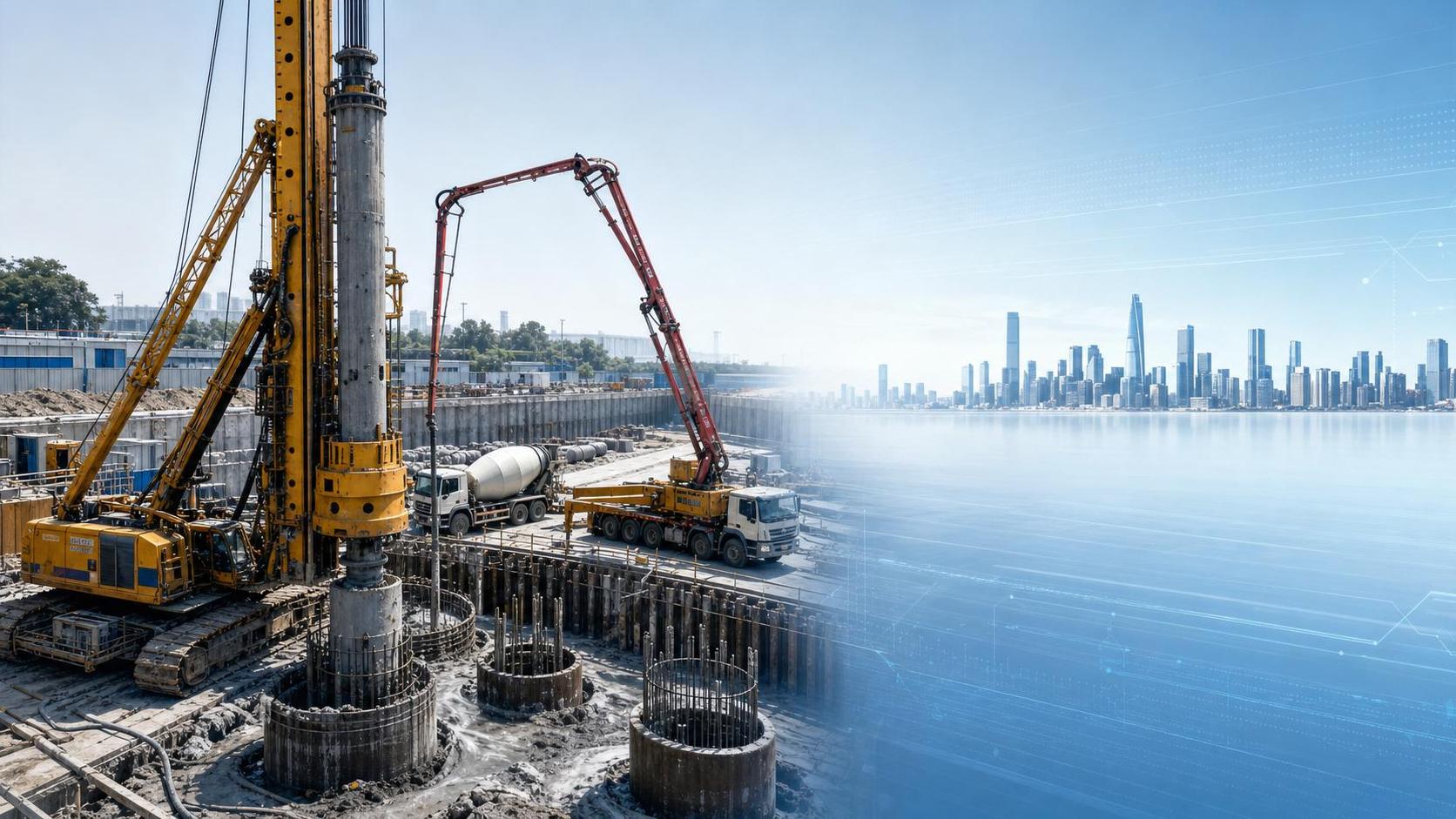
Why do mega-infrastructure projects cost more than the first budget suggests?
Mega-infrastructure projects cost rarely drifts upward because of one dramatic event.
The overrun usually begins much earlier, when scope assumptions look firm but remain only partly tested.
In large civil works, the biggest financial pressure points sit below the visible structure.
Ground behavior, pile depth, pumping distance, batching stability, haul routes, and sequence planning shape final cost more than many early models admit.
That is why mega-infrastructure projects cost must be reviewed as a system, not as a materials spreadsheet.
A bridge, metro station, port terminal, or supertall tower can appear commercially viable on paper.
Then foundation redesign, slurry disposal, concrete delivery delays, or equipment mismatch quietly change the entire economics.
In practice, the earliest budget mistakes often come from underpricing uncertainty rather than underpricing steel or cement.
This is also where specialist intelligence matters.
DFCS follows concrete batching, pumping machinery, rotary drilling rigs, and piling systems because these assets often determine whether initial assumptions survive real site conditions.
Where do budget overruns usually begin in heavy civil and foundation work?
They usually begin where early certainty is overstated.
The most common starting points are not hidden, but they are often fragmented across teams.
- Incomplete geotechnical investigation that later changes drilling tools, pile type, or shaft depth.
- Procurement decisions based on nominal capacity instead of actual cycle time and site constraints.
- Concrete supply planning that ignores traffic windows, pour continuity, and seasonal temperature control.
- Environmental compliance costs added after equipment selection.
- Interfaces between designers, contractors, and equipment suppliers left commercially undefined.
For example, a rotary drilling rig may meet diameter requirements on paper.
If hard rock wear rates are misread, tool consumption and idle time can change the foundation budget within weeks.
The same pattern appears in concrete pumping.
A boom pump with impressive reach can still create cost escalation if pipe routing, slump consistency, and pressure loss were not modeled against the real pour sequence.
So when asking why mega-infrastructure projects cost rises, the more useful question is this:
Which early assumption is least verified, yet most expensive if wrong?
Is ground risk still the biggest trigger, even when equipment budgets look controlled?
Yes, and often by a wide margin.
Ground risk changes design, production rate, spoil handling, energy use, and safety controls at the same time.
That combination makes it one of the fastest ways for mega-infrastructure projects cost to move beyond approval thresholds.
A shallow misunderstanding of strata can distort several decisions at once.
Pile lengths may increase. Casing demand may rise. Drill bits may wear faster. Pumping schedules may shift because foundation completion slips.
More common than dramatic collapse is slow financial erosion.
Daily production falls below the commercial baseline, and the budget absorbs the difference.
DFCS sector tracking repeatedly shows that underground works deserve higher attention in cost validation than their early headline share might imply.
The reason is simple.
Once deep foundation methods are mobilized, redesign is possible but rarely cheap.
A quick check table for early warning signs
Before final approval, it helps to compare the budget line against the field condition that can destabilize it.
How do equipment and procurement decisions distort mega-infrastructure projects cost?
The distortion usually starts when purchase price is treated as the main cost signal.
For large infrastructure, the better measure is production reliability under real operating constraints.
A lower-priced mixer fleet may look attractive.
If it cannot preserve concrete quality across long haul distances or hot-weather windows, the apparent saving disappears quickly.
The same applies to batching plants.
High-precision weighing, enclosed dust control, and digital monitoring can appear secondary during approval.
Yet on high-volume pours, these systems support consistency, reduce rejected loads, and avoid disruption from environmental enforcement.
That is why mega-infrastructure projects cost should include operational fit, not just asset price.
A useful procurement review asks four direct questions.
- Can the equipment sustain the target cycle under the worst expected geology or weather?
- Are consumables and wear parts locally available at the required pace?
- Do emission, dust, and noise standards force a different configuration later?
- What is the cost of idle crews if one critical machine underperforms?
Procurement becomes much stronger when these answers are attached to the budget before mobilization.
Why do logistics and sequencing create overruns even after contracts are signed?
Because signed contracts do not remove physical bottlenecks.
They only allocate responsibility for them.
Mega-infrastructure projects cost often rises when planners assume that delivery, pumping, drilling, curing, and disposal can be optimized separately.
On site, these operations are tightly linked.
A delayed mixer arrival can break pour continuity.
A slow spoil removal plan can stall drilling rigs.
Restricted urban working hours can force higher-capacity equipment or weekend premiums.
This is especially relevant in dense city projects, where pump trucks, static piling systems, and enclosed batching operations are selected not only for output, but for compliance and access.
More common than legal dispute is simple sequencing failure.
The project keeps moving, but at a cost curve that no longer resembles the approved model.
That is one reason DFCS places strong emphasis on equipment shortlisting standards and lifecycle efficiency, not only technical specifications.
What should be checked before approving a budget for major concrete and deep foundation packages?
A sound review does not need hundreds of indicators.
It needs the few that reveal whether the estimate is resilient.
The following checks usually expose where mega-infrastructure projects cost may later expand.
- Confirm whether geotechnical data density matches foundation complexity, not just site size.
- Separate rated machine performance from expected field performance.
- Test the concrete supply chain against haul distance, queue risk, and pour continuity.
- Price consumables, wear parts, and maintenance windows into the baseline.
- Check if environmental rules could push electrification, enclosure, or low-noise methods.
- Review interface risk between civil design, equipment selection, and subcontract scope.
It also helps to ask for one downside scenario, not only the target case.
If the budget remains credible under harder rock, longer queues, or lower pump efficiency, the approval is on firmer ground.
So where should the next review focus if cost pressure is already visible?
Start with the earliest assumption that now looks operationally weak.
Do not begin with general austerity measures.
In most cases, budget recovery comes from correcting a technical-commercial mismatch.
That could mean revisiting pile methodology, adjusting batching configuration, reworking haul logic, or replacing a pump setup that is underperforming in real conditions.
Mega-infrastructure projects cost becomes easier to control when review moves from headline totals to cost origins.
The practical next step is to map scope, geology, equipment, logistics, and compliance into one decision frame.
That creates a clearer basis for comparing revised scenarios and judging which risks still sit outside the budget.
For projects built on concrete intensity and deep foundation complexity, that discipline matters more than any single unit price.
It is usually the difference between a budget that survives execution and one that unravels underground.
Industry Briefing
Get the top 5 industry headlines delivered to your inbox every morning.