
Which safety standards apply when selecting a concrete pump?

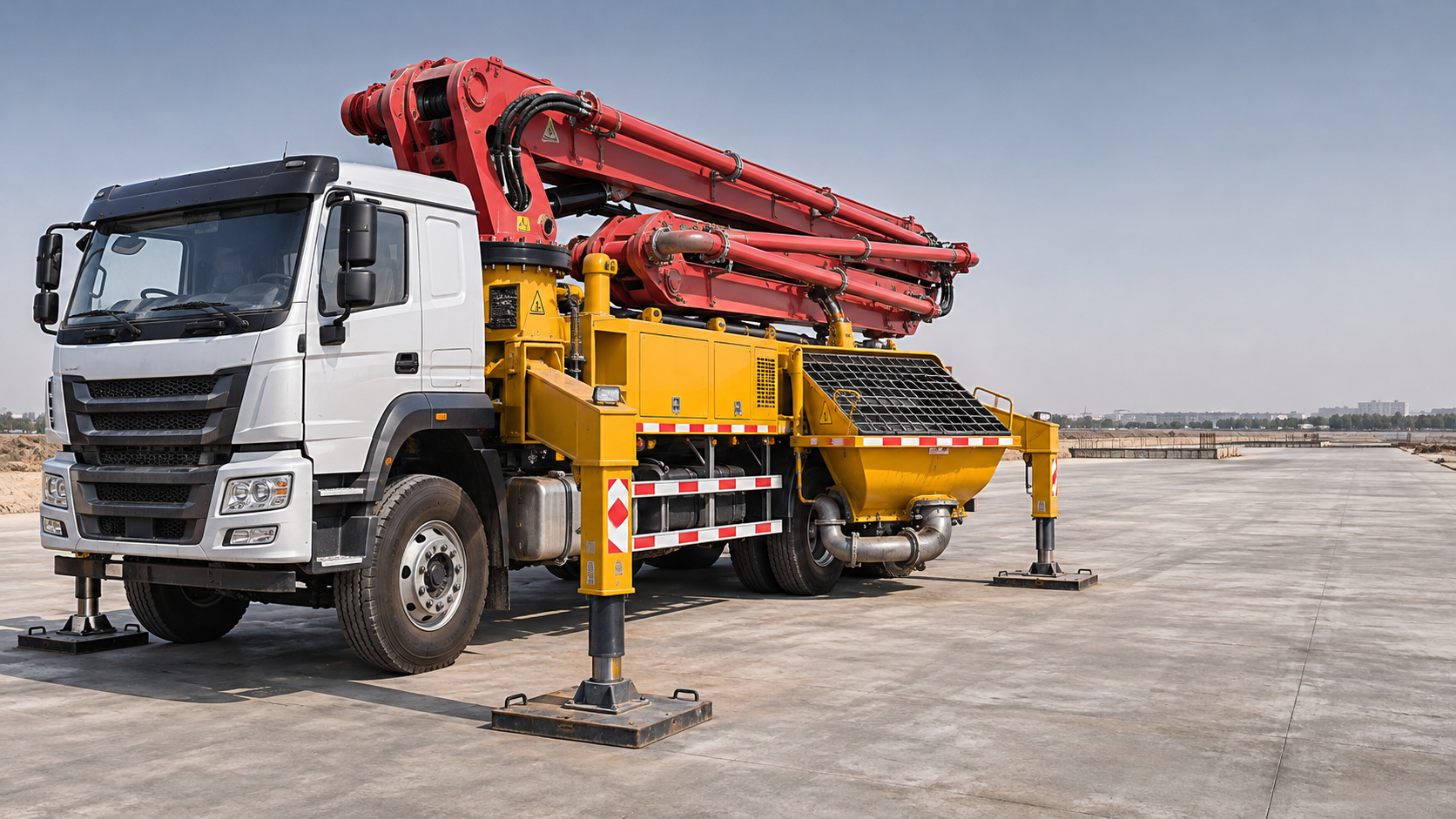
Selecting a concrete pump involves more than comparing output capacity and boom reach. Equipment selection by standards means checking machinery safety requirements, guarding, stability, hydraulic systems and documentation against the intended application and local regulations. EN 12001 and ASME B30.27 are relevant reference points, but neither should be treated as a universal approval for every market or every machine.
The practical question is not simply whether a supplier can name a standard. It is whether the complete pump configuration can be placed on the market, operated and maintained safely where the work will take place. That includes the chassis, placing boom, delivery line, remote control and site setup—not just the pumping unit.
Start with the machine and its destination
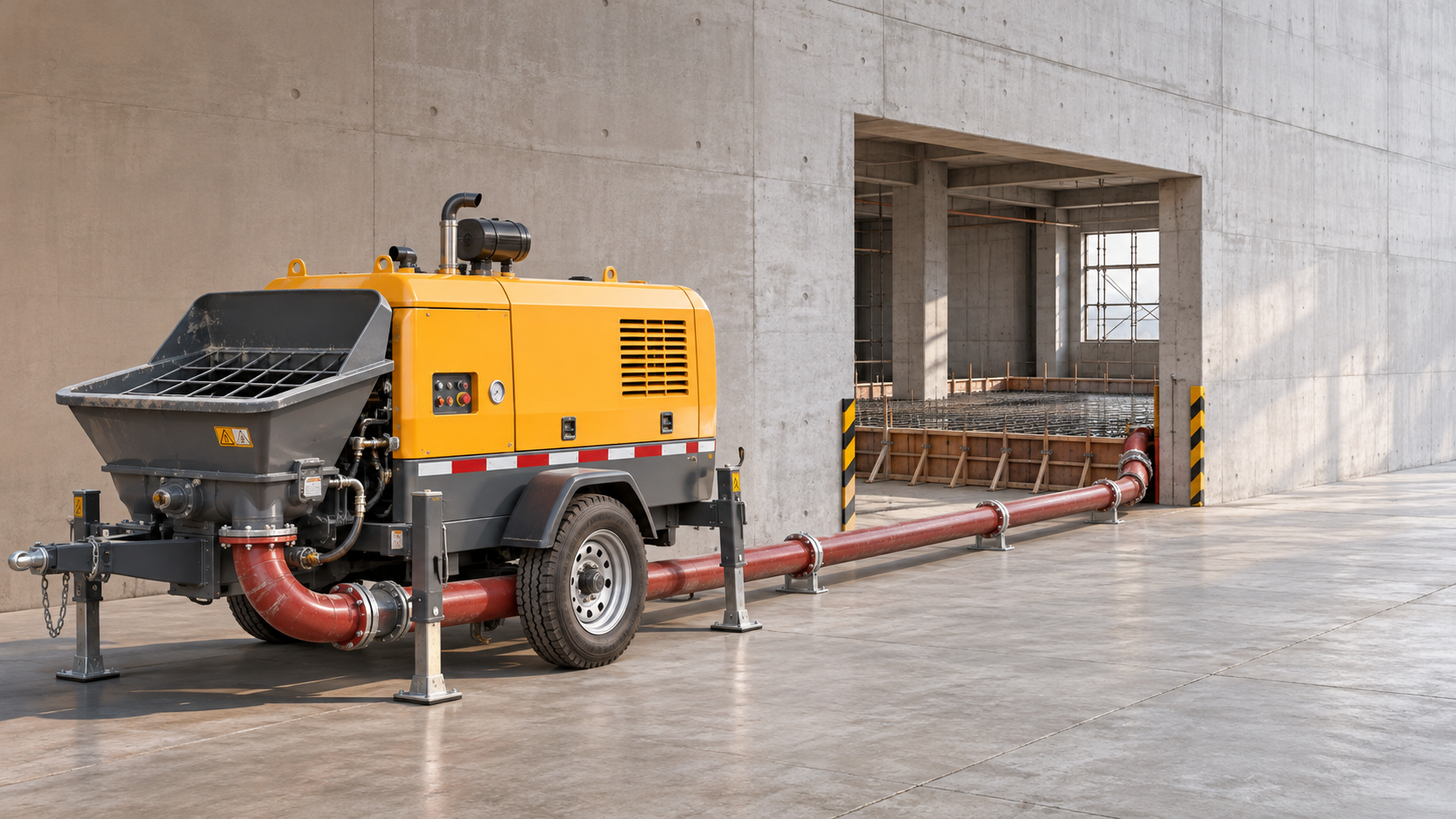
A truck-mounted boom pump, a trailer-mounted line pump and a stationary pump feeding a separate placing boom present different combinations of hazards. A boom pump raises questions about deployment, outrigger loads, overhead obstructions and structural inspection. A stationary system may depend more heavily on pipeline routing, anchorage and the interfaces between equipment supplied by different parties.
Before comparing standards, define the destination market, date of supply, machine type and intended duty. Record whether the purchase covers a complete assembly or individual components. Also identify foreseeable uses: high-rise pumping, confined urban sites, long horizontal lines or operation near excavations can each change the assessment.
The applicable legal requirements depend on jurisdiction and timing. A standard may be voluntary in itself but become contractually required, cited by a regulator or used to demonstrate conformity with legal obligations. Always check its scope and edition, and distinguish the rules for placing equipment on the market from those governing its use on a construction site.
The main concrete pump standards to investigate
EN 12001: concrete and mortar conveying machinery
EN 12001 addresses safety requirements for machinery used to convey, spray and place concrete and mortar. It is a key starting point when evaluating equipment intended for European markets. Its scope, exclusions and applicable edition should be checked against the exact machine and intended date of supply.
For an EU purchase, ask the manufacturer which legislation applies and which harmonised standards it has used. A harmonised standard cited in the EU Official Journal can provide a presumption of conformity with the legal requirements it covers, subject to its citation and conditions. A reference to EN 12001 alone does not demonstrate that every applicable obligation has been met.
The EU Machinery Directive 2006/42/EC is replaced by the Machinery Regulation (EU) 2023/1230 from 20 January 2027, subject to the regulation’s transitional provisions. For deliveries around that date, establish which framework applies to the particular transaction rather than assuming that the same documentation is sufficient for both.
ASME B30.27: material placement systems
ASME B30.27 covers material placement systems, including concrete pumps and associated placing systems within its scope. It is an important reference for equipment used in the United States and elsewhere when specified by a project or contract. Its provisions address areas such as construction, installation, inspection, testing, maintenance and operation.
ASME B30.27 is not automatically a substitute for local law. Check whether a state, local authority, contract or site owner has adopted a particular edition or imposed additional requirements. In the United States, relevant OSHA construction rules may also apply; for example, 29 CFR 1926.702 addresses certain concrete and masonry construction equipment and operations. The applicable obligations depend on the equipment and task.
Supporting standards are not interchangeable
Depending on the design and jurisdiction, evaluators may also encounter ISO 12100 for machinery risk assessment and risk reduction, ISO 4413 for hydraulic fluid power safety, and ISO 13849-1 for safety-related parts of control systems. These can support the assessment of particular hazards or design functions; they do not replace the machine-specific standard or the manufacturer’s legal responsibilities.
Ask the supplier to identify the standards actually applied, including editions and relevant scope. A list of familiar numbers without a connection to the supplied configuration is weak evidence.
Translate the standards into physical checks
A useful technical review follows the hazards through a normal pumping cycle: setup, priming, pumping, blockage removal, cleaning, maintenance and transport. Several issues deserve particular attention because they often sit between the manufacturer’s design and the contractor’s method of work.
Stability and supporting ground
For a boom pump, request the permitted outrigger configurations, corresponding working limits and manufacturer-specified support reactions or loads needed for site planning. Compare these with the actual setup area, underground services, excavation edges and the ground’s assessed bearing capacity. The use of pads or mats must be compatible with both the manufacturer’s instructions and the site’s ground assessment.
Restricted outrigger deployment deserves special scrutiny. Do not assume a machine can use its full boom envelope when space prevents normal setup. Check whether the manufacturer permits the proposed configuration, what limits apply and how the operator is informed of them.
Delivery pressure and pipeline integrity
Compare the pump’s maximum concrete pressure with the pressure ratings of pipes, bends, couplings, seals and hoses. The relevant limit is not necessarily the rating printed on a new straight pipe: the complete line must be suitable for the foreseeable pressure and service conditions. Confirm compatibility between components, including connections supplied separately from the pump.
Wear changes the decision. Bends and reducers can deteriorate differently from straight sections, while high-rise systems may need secure anchorage to resist operational forces. Request inspection and replacement criteria, including how wall thickness is checked where the manufacturer requires it. A high-pressure pump paired with poorly documented line components is not a complete technical solution.
Blockage clearing is another pressure hazard. The operating instructions should explain how pressure is relieved and verified before a line is opened, and who is authorised to carry out the work. Reversing the pump is not, by itself, proof that all trapped pressure has been eliminated.
Hopper guarding and moving parts
The hopper area exposes personnel to moving components and hazardous material flow. Evaluate the guard’s design, access points and any associated interlocks against the applicable requirements and manufacturer’s instructions. The review should also consider what happens during cleaning, clearing and maintenance, when personnel may be tempted to defeat safeguards.
Ask how hazardous motion is isolated and how stored hydraulic or other energy is controlled before access. A guard that is difficult to clean around may create operational pressure to remove it; that is a design and procedure issue to resolve before the machine arrives on site.
Controls, hydraulics and remote operation
Check the location and behaviour of emergency stops, protection against unintended movement, and the response to loss of power or control signal. For radio-controlled machines, establish how control is transferred, what happens if communication is interrupted and how the operator maintains a safe view of the operation.
Hydraulic faults can affect boom movement, stabilisation and maintenance safety. Request information on protective devices, safe isolation, hose inspection and procedures for dealing with stored energy. If the supplier claims a safety-related control function meets a particular performance level, ask which function was assessed and what evidence supports the claim.
What documentation should accompany a serious comparison?
Documentation should identify the actual machine, not merely a product family. For a truck-mounted unit, check that the pump, boom and chassis combination matches the records. Modifications, replacement booms and third-party controls may alter the assessment and should be traced.
Depending on market and equipment type, request the applicable declaration of conformity, instructions in the required language, identification details, rated limits, setup instructions and maintenance schedules. For used equipment, add inspection history, records of structural repairs, changes to safety functions and evidence of outstanding defects or manufacturer safety notices being addressed.
A CE marking, where applicable, is a manufacturer’s declaration of conformity; it is not evidence that a regulator has individually approved the machine. Likewise, a third-party certificate should be checked for its scope: it may concern a component or management system rather than the complete pump.
Use the site scenario to resolve close comparisons
Consider two pumps with similar advertised output. One may have adequate pressure for the proposed vertical line but insufficient documented pipeline compatibility. The other may meet the pressure requirement but cannot deploy its outriggers within the available footprint. Neither issue is resolved by a larger theoretical output figure.
Concrete properties matter too. Aggregate size, mix behaviour, line diameter, bends and elevation affect pumping resistance. Ask the supplier to assess the intended duty using project-specific information, while keeping pressure ratings and operating limits separate from estimates of achievable output. Changes in concrete mix or pipeline layout may require the assessment to be revisited.
For high-rise and underground construction, this interface between pumping pressure, temporary works and site constraints is central to the equipment intelligence covered by the Global Deep Foundation & Concrete Systems (DFCS). The same discipline applies to a smaller purchase: document the operating envelope before selecting the machine, rather than trying to adapt the site after delivery.
Make compliance verifiable before purchase
A practical comparison matrix should connect each applicable requirement to evidence: the standard and edition, the relevant machine configuration, the supplier’s document or inspection record, and any unresolved site responsibility. Mark assumptions explicitly, especially where the pipeline, placing boom or chassis comes from another supplier.
Before issuing a final specification, confirm the destination’s current legal framework, the required documentation, the proposed support conditions and the pressure rating of the complete delivery system. Any gap that cannot be checked from the documents should become a technical query—not an assumption carried into commissioning.
 Which safety standards apply when selecting a concrete pump?Time : Nov 12, 2026
- When should a trailer pump be used instead of a boom pump?Time : Nov 04, 2026
- How much does a trailer concrete pump cost to buy?Time : Nov 01, 2026

Industry Briefing
Get the top 5 industry headlines delivered to your inbox every morning.